Honda Model Review: Civic versus HR-V
A head-to-head look at the 2018 Honda Civic and HR-V, weighing fuel economy, cargo space, safety, comfort, design and price to help decide which fits your life.
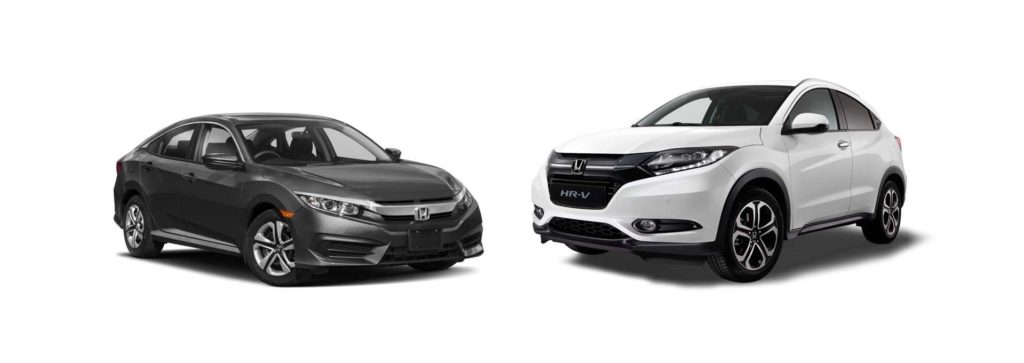
It ultimately comes down to which car best fits your needs and lifestyle.
Our reviewerSporty and Efficient, or Adventurous and Roomy?
Stepping into 2018, the Civic and HR-V represent two very different answers to the same Honda reliability. Having owned both, the choice ultimately comes down to which car fits your needs and lifestyle rather than one model being objectively better.
Fuel economy clearly favors the Civic, which posts 42 mpg highway and 32 mpg city against the HR-V's 32 mpg highway and 27 mpg city — a meaningful gap for anyone with an above-average commute. Cargo space flips that result entirely: the HR-V's Magic Seat technology, with a folding-flat and flip-up rear seat plus a fold-back front passenger seat, expands capacity to 23.2-58.8 cubic feet, dwarfing the Civic's 11.9-25.7 cubic feet.
On safety, the Civic sweeps the NHTSA crash-test categories with 5 stars across front, front passenger, overall and rollover ratings, while the HR-V manages 4 stars in those same categories (5 stars in rear collisions) — though its lower acceleration may also mean fewer opportunities to crash in the first place.
Comfort splits along similar lines: the Civic's smaller cabin suits shorter drivers and smaller groups, while the HR-V is built more for a family, with firmer front seat cushions for anyone who prefers that over plush. Both models include heated seats and automatic climate control.
Design and price come down to preference and circumstance more than a clear winner — the Civic leans sleeker and appeals to a younger buyer, the HR-V reads as a more grown-up first vehicle or family option, and their base MSRPs land close enough to each other that price shouldn't be the deciding factor.
Living With Both
Owning both models side by side made the trade-offs concrete rather than theoretical. The Civic's fuel economy is the standout for daily driving — 42 mpg highway makes a real dent in fuel costs for anyone with a longer commute — while the HR-V's Magic Seat system turned out to be the more practical feature day-to-day, letting the rear seat fold flat or flip up and the front passenger seat fold back for longer cargo.
Behind the wheel, the Civic felt like the more confident, sportier drive, backed up by a clean sweep of 5-star NHTSA ratings. The HR-V felt steadier and more family-oriented, with firmer front seats that some in our household preferred over the Civic's plusher setup.
Price Isn't the Deciding Factor
Base MSRP between the two models lands close enough that it shouldn't tip the decision either way — the real trade-offs are fuel economy and safety scores versus cargo space and family-friendly features.
We Recommend This To Readers Who:
-
New drivers and daily commuters
The Civic's fuel economy and price make it the practical daily-driver pick.
-
Car mod enthusiasts
The Civic's sleeker design skews toward a younger, customization-minded buyer.
-
New parents
The HR-V's Magic Seat cargo system and family-oriented comfort are built for the job.
-
Adventurous road-trippers
The HR-V's up-to-58.8-cubic-foot cargo capacity handles gear a Civic can't.
-
Professionals wanting a first grown-up vehicle
The HR-V reads as the more mature, professional option of the two.
A Closer Look


Which Honda Is Right For You
Both the Civic and HR-V are safe, reliable choices — the decision comes down to whether fuel economy and price top your list, or cargo space and family practicality do.